Africa week: a moment to celebrate, reflect and connect.
Anele Mngadi and Calton Mupande, International Office Staff, Nelson Mandela University
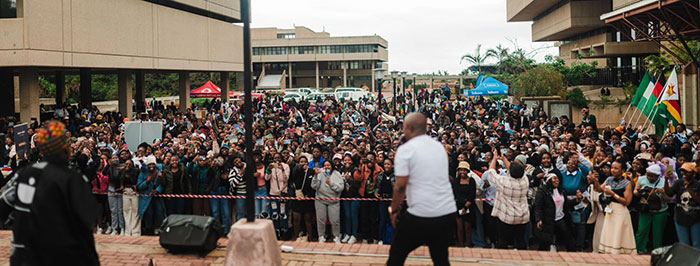
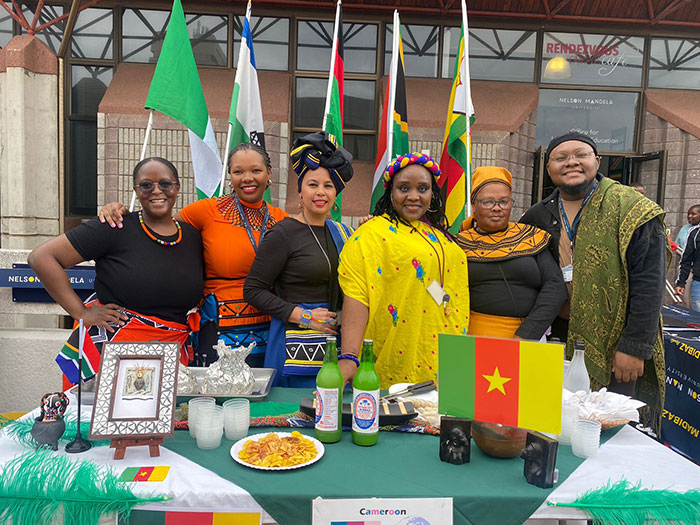
Nelson Mandela University’s International Office (MIO) collaboratively organised and hosted various week-long activities to acknowledge, recognise and celebrate Africa’s rich cultural heritage and diversity. These events included a symposium, seminar, a silent protest to raise awareness of the war in the Democratic Republic in Congo (DRC) and Africa Day Arts Festival on May 24, filled arts and crafts, traditional food, traditional dances, traditional attire exhibitions, music and entertainment. This was a build up to Africa Day, 25 May that is celebrated annually. Africa Day is about the commemoration of the founding of African Union (formerly Organisation of African Unity founded on 25 May 1963 as well as the continent’s successes and aspirations for the present and the future. This year’s theme is ‘Education Fit for the 21st Century’.
The higher education sector has an important role to embrace and promote diversity in a world where some countries are increasingly leaning to far right and left and adopting nationalistic tendencies. In Africa, a continent that still bears scars of the past (colonization), neo-colonization and divisions based on tribe and nationality as well as underdevelopment, a lack of appreciation of diversity and cultures is often glaring. The International Office at Nelson Mandela University together with different stakeholders in advancing the university’s internationalization and community engagement agenda hosted educative initiatives that not only entertained high school and university students but also the broadened the society’s understanding of diversity on the continent.
Amongst the weeklong activities, the Africa Day Arts Festival hosted by Mandela International Office in collaboration with Madibaz Radio and the department of Arts and Culture brought together South African and International students as well as international residents based in Gqeberha through arts and craft, traditional food and attires exhibitions as well as musical entertainment. Students and the broader community we treated to a tapestry of traditional cuisine from various provinces in South Africa, Ghana, Nigeria and Eritrea. Furthermore, Music and dance by students and the acapella outfit, ‘The Soil’ captivated the crowd. The ability of Nelson Mandela University to work collaboratively with the community demonstrates its embeddedness in and the vision to serve the society and promote tolerance, appreciation of diversity and the richness of the African continent. Universities ought to be open to the broader society and foster formal and informal education.
Besides the Africa Day Arts Festival, Mandela International Office and the Centre for the Advancement of No-Racialism and Democracy hosted the inaugural ‘Africa Month Symposium’ which highlighted diverse perspectives on education on the continent. The keynote address was delivered by Prof Kwesi Kwaa Prah. In addition, MIO hosted a seminar titled: ‘Towards a Borderless Afrika-Implications for Political and Socio-Economic Matters. A Pan-Afrikanist Perspective’. The symposium’s speakers offered different perspectives and engaged on opportunities and potential challenges of a borderless Africa. The seminar attracted audience from Phakamisa High School and activist groups from Kariega and Bayland. Lastly, a day was allocated to the #FreeCongo and #StandWithDRC movement to expose the silent genocide and humanitarian crisis that is underway in some parts of the DRC.