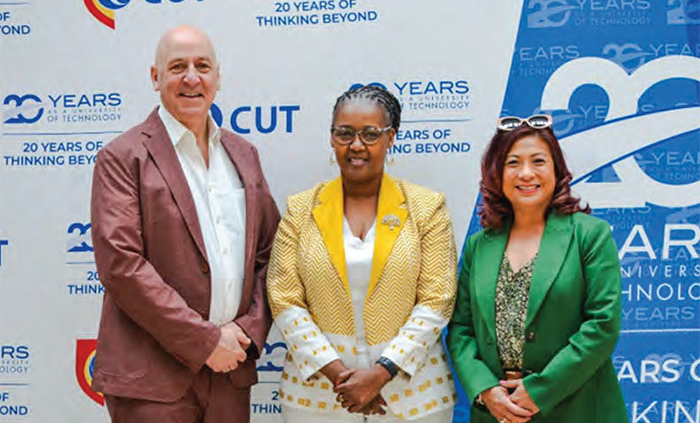
CUT Vice-Chancellor and Principal Prof. Pamela Dube hosted renowned higher education experts in a series of discussions at the Bloemfontein Campus to stimulate conversations on current topics in the sector. The two experts, Prof Mahoney, a global Leader in Education, Performance Psychology, and Innovation, and Dr Helena Lim, a higher Education Thought Leader and academic and Institutional Data Researcher, co-presented a public lecture on the Global Challenges in higher education. During the lecture, they led the discussions on how universities could drive breakthroughs across various fields to contribute to the UN’s sustainable goals and the importance of higher education in preparing for an uncertain future and achieving sustainable development goals. The lecture also included an opportunity for audience participation, in question-and-answer session as well as networking. The lecture delved into the most crucial global challenges in higher education, such as the digital divide, funding, and student health. It also underscored the significance of international collaboration and local impact, including sharing best practices to benefit local communities in areas such as public health and climate challenges. The lecture also touched on the increasing demands for international students in the UK, the innovation resulting from the Covid pandemic, and the shift toward more real-world solutions through partnership and innovation hubs, such as the improvement in additive manufacturing. In her remarks, Prof Dube said she had the privilege of working with Prof Mahoney for many years., “Our professional relationship, which began during my time at UWC, has been marked by our shared commitment to addressing issues of interest, particularly equitable access and success for students regardless of their backgrounds.

Author: Lesego Modisenyane

Orla Quinlan

Developing partnerships with African institutions workshop

The Association of International Education Administrators (AIEA) Conference, specifically for those leading international education at higher education institutions, was held from February 18 -21, 2024, at the Marriot Marquis in Washington DC.

IEASA continued its strategic partnership activities with the AIEA and facilitated a four-hour workshop on Developing partnerships with African institutions, on February 18th, 2024.

The workshop included an introduction to IEASA by Orla Quinlan, Director of Global Engagement, Rhodes University; President of IEASA (2019-2020). A theoretical overview of types of partnerships was presented by Dr Nico Jooste, Senior Director, AfriC; President of IEASA (2015-2016).  

Examples of successful African-US partnerships from South Africa institutions and the University of Botswana were shared, during the four-hour workshop, which also included exploratory group work and discussion about potential funding opportunities.

The South African IEASA institutional members who shared examples of successful partnerships from their respective contexts included: Refilwe Moleyane, Central University Technology, Carlien Jooste, Sefako Makgatho Health Sciences University (online) and Orla Quinlan, Rhodes University. Dawid Katzke, Deputy Vice Chancellor: Finance and Administration, University of Botswana concluded the African specific input. Shahzad Ahmad, St Cloud State University, USA, followed and shared his extensive experience of working with partnerships in Africa and all over the world.

Strategic engagement between AIEA and IEASA in the future

At an open session with the AIEA leadership on future strategy, IEASA was invited to share their view of ways in which the two organisations could continue to work together in the future. Representing IEASA in the session, Orla Quinlan, Rhodes University, suggested that the two organisations could continue to organise joint events such as the Global Leadership Summit, which was held just before the IEASA jubilee conference in Durban in August 2023, organise joint workshops and webinars, on contemporary and relevant topics, and continue participation in each other’s conferences.

Congratulations to Amit Reza, President AIEA 2004-2005

IEASA congratulates Amit Reza, Dean of Babson Academy for the Advancement of Global Entrepreneurial and Dean of Global Education at Babson College, who was recently elected as the President of AIEA, 2024-2025. This marks a moment in time when the current President, the Past President (2024-2025), Jeet Joshee, California State University-Long Beach; President-Elect (2024-2025), Paulo Zagalo-Melo, Western Michigan University, are all former international students in the US.

A fond Farewell to the Executive Director of AIEA

Darla Deardorff, the AIEA, Executive Director, a long- time supporter of IEASA, who was instrumental in developing the partnership between IEASA and AIEA, announced her intention to step down as the AIEA Executive Director at the recent AIEA conference. Darla plans to devote more time to peace building which is her passion through other projects including her UNESCO Chair on intercultural competency, hosted by Stellenbosch University. We thank Darla for her consistent engagement with IEASA, bringing the working relationship of the AIEA and IEASA closer together and look forward to continuing to work with her in different ways in the future.

Rhodes University’s 120th anniversary project in 2024 is a year-long celebratory programme packed with diverse activities, including reunions, high-level societal debates, unveilings, exhibitions and cultural activities, which started with a seminal education summit to further strengthen quality education as Makhanda’s unique selling point.

Convened under the auspices of the Vice-Chancellor’s Education Initiative championed by Professor Sizwe Mabizela, the multi-stakeholder summit was the first of its kind in the country. https://www.ru.ac.za/latestnews/makhandaeducationsummitpavingthewayforaneweraineducationalexcellenc.html

The RU120 events calendar includes academic and research showcases such as the initiation of the Internet in South Africa in 1991, a game-changing project in which Project Sponsor for RU120, Professor Peter Clayton, was involved, community engagement accomplishments that saw the University win the Mac Jannet Global Citizen Prize https://www.ru.ac.za/latestnews/rhodesuniversityisfirstsauniversitytowintopspotformacjannetglobalci.html and launch the Community Engagement journal – another first for Africa – and the teaching and learning statistical data that sets Rhodes University apart as the cauldron of scholarly excellence.

Highlights on the RU120 programme include:

  • Vice-Chancellors from different Eastern Cape universities in dialogue addressing pressing social, economic, political, and ethical concerns.
  • High-level current affairs reflections and debates.
  • A Journalism Summit to explore journalism’s role in today’s world as the cornerstone of democracy and human advancement.
  • High-level political, community and business leaders are scheduled to contribute to meaningful discussions about the future of South Africa.
  • Emeritus History Professor, accomplished author and the University’s longest-serving Orator, Paul Maylam, explores Rhodes University’s intellectual history.
  • Bringing the present and future into sharper focus, the grand opening of the R90 million Institute for Nanotechnology Innovation building will take place – which will house the ground-breaking research being done by Professor Nyokong and her dedicated students.

From sports festivals to parades and art exhibitions, celebrants will not be short on cultural options to explore. An orchestral ensemble comprising the Nelson Mandela University Orchestra, the Rhodes University Orchestra, and the Makhanda Community Orchestra will forge a memorable auditory backdrop for the year.

Towards the end of the year, a legendary reunion is planned, bringing together some of the oldest alumni who fondly refer to themselves as ‘Knocking on Heaven’s Door’. These individuals, who vividly recall their early 1970s protests advocating for the inclusion of Black students at Rhodes University, have aptly named their bittersweet gathering ‘The Final Countdown’.

RU120 is more than just a celebration – it is a strategic and inclusive initiative that aims to address contemporary challenges like student debt and educational reform strategically, Prof Mabizela says: “This multifaceted approach, predicated on diversity and collaboration between stakeholders, symbolises a significant step in honouring the past, engaging with the present, and envisioning continued positive future impact on the community and the broader educational landscape”.

For more information on everything RU120-related, please visit the regularly updated official RU120 website https://ru120.ru.ac.za/

Date:               02 February 2024

Author:            Leonie Bolleurs

Photo:             Stephen Collett
Link:                African languages, gender, and sexualities explored in newly launched Thetha Sizwe

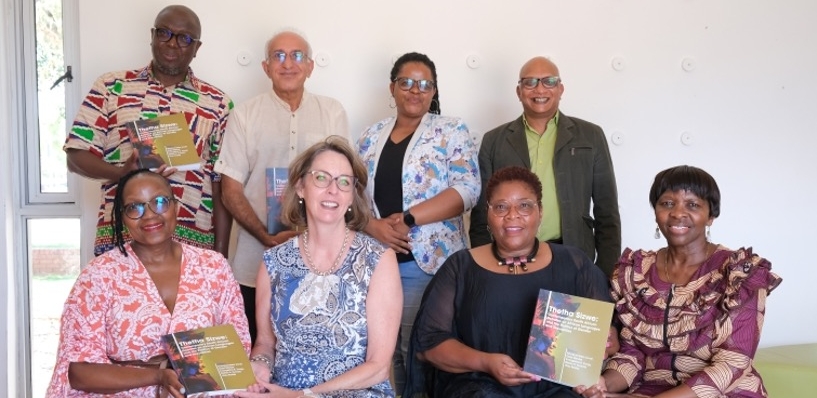
The book, ‘Thetha Sizwe: Contemporary South African Debates on African Languages and the Politics of Gender and Sexualities’, saw the light six years after the idea for this publication was conceived. The launch took place on the Bloemfontein Campus of the University of the Free State (UFS).

In her welcoming words, Dr Engela van Staden, former Deputy Vice-Chancellor: Academic at the UFS, expressed that the message she took away from this book is the crafting of new philosophical spaces, particularly for the UFS in its effort to develop Sesotho as an academic language. “I see this as a foundational work that can be used not only in schools but also in universities because it shapes a theory to be further debated. This work sheds light on cultural dimensions that are currently very pertinent in higher education.”

Dr Van Staden also expressed the hope that the Academy for Multilingualism at the UFS will use these learnings for the benefit of education at the university.

At the event, Prof Mogomme Masoga, Dean of the Faculty of The Humanities – who also provided a short review on the back cover of the book – congratulated the authors for a well-executed job. “Without language, we are nothing. The authors have helped us to think about issues that are affecting us. It was a brave task to look at language and incorporate social and political issues into that,” he said.

Understanding inequalities in the broader human and social dimension

Prof Vasu Reddy, Deputy Vice-Chancellor: Research and Internationalisation (UFS) and one of the editors and authors, provided an overview of the book’s genesis. He explained that this collection of essays is a product of a funded project by the Andrew Mellon Foundation. According to him, Thetha Sizwe is part of a programme titled: Justice and Humanity: Challenging World Inequalities. He emphasised that the key to the project lies in the concept of understanding inequalities in the broader human and social dimensions – a contemporary global problem.

Prof Reddy is of the opinion that the term ‘inequality’ often places excessive emphasis on economic and wealth indices at the expense of humanistic constructions, presenting limitations to our understanding of this issue. Moreover, the term is a weighty word carrying shades of meaning that question and probe the meaning of ‘equality’. “It brings forth issues of unevenness, disproportion, and the lack of fair and just treatment. Equality is something we all strive for and want and demand. It is one of the world’s most potent human ideals – a constant social concern,” he said.

Prof Reddy stated that this is a book that takes readers into the storylines of language and gender. “Languages are not just innocent tools. They convey so much in a social dimension. They also represent the social structures in our societies and have bearing on social identity. Language intersects with a range of identity markers such as class, race, and sexuality.”

Besides Prof Reddy, the other authors who attended the event and engaged in a panel discussion about the book included Dr Gabisile Mkhize, Dr Bonakele Mhlongo, and Dr Phindile Dlamini from the University of KwaZulu-Natal, as well as Prof Nompumelelo Zondi from the University of Pretoria. The book was published by ESI (Emerging Scholars Initiative) Press and is available to the public free of charge.

Date: 31 January 2024
Author: Anthony Mthembu
Photo: Supplied
Link: UFS Achieves Double Honours at Inaugural Chartered Global Management Accounting (CGMA) Professional Awards Africa

The University of the Free State (UFS) has proudly clinched two prestigious awards at the inaugural Chartered Global Management Accountant (CGMA) Leadership Award ceremony. Organised by the Association of International Certified Professional Accountants, comprising AICPA and CIMA, this event recognises the continent’s outstanding contributions to the finance and accounting industry.

The UFS secured the coveted CGMA Leadership Award for ‘Excellent University Partner (Top 10 in Africa).’ This accolade underscores the institution’s commitment to advancing the finance and accounting sector. The presentation took place at the awards ceremony held in Johannesburg on 24 November 2023, marking a significant achievement for the UFS.

Prof Frans Prinsloo, Vice-Dean of Learning, Teaching, Innovation, and Digitalisation in the Economic and Management Sciences (EMS) Faculty at the UFS, views the award as a testament to the alignment of the academic programmes with the standards of leading professional accountancy bodies in South Africa, including the Chartered Institute of Management Accountants (CIMA).

Prinsloo stated, “We have worked diligently to align our academic programmes with the requirements of key potential professional bodies, positioning ourselves as an educator of choice. This recognition, alongside our other accreditations, confirms our success in achieving this goal.”

A global educator recognised

Further enhancing the UFS’s recognition, Michelle de Lange, Lecturer in the School of Accountancy and Programme Coordinator of the B.Com Honours in Management Accounting, received the ‘Elite University Educator of the Year Award’ in the CGMA Leadership Award category. Nominated by her students and colleagues, De Lange expressed her honour and surprise at winning, highlighting her commitment to delivering valuable content to her students.

De Lange shared her perspective, stating, “To compete against phenomenal educators was a privilege, and winning signifies that my efforts are making a positive impact on students and colleagues alike.”

According to Prinsloo and De Lange, these accolades affirm the institution’s dedication to producing top-class accountancy and finance graduates.

A global educator recognised

Further enhancing the UFS’s recognition, Michelle de Lange, Lecturer in the School of Accountancy and Programme Coordinator of the B.Com Honours in Management Accounting, received the ‘Elite University Educator of the Year Award’ in the CGMA Leadership Award category. Nominated by her students and colleagues, De Lange expressed her honour and surprise at winning, highlighting her commitment to delivering valuable content to her students.

De Lange shared her perspective, stating, “To compete against phenomenal educators was a privilege, and winning signifies that my efforts are making a positive impact on students and colleagues alike.”

According to Prinsloo and De Lange, these accolades affirm the institution’s dedication to producing top-class accountancy and finance graduates.

Date:               18 January 2024

Author:            Leonie Bolleurs

Photo:             Kaleidoscope

Link:                UFS among Top Ten Best Value Universities for International Students in SA

Study Abroad Aide (SAA) recently ranked the University of the Free State (UFS) as the eighth best value university for international students among 39 universities in South Africa and placed the university among the top 13% of universities in the Best Value University World Rankings.

SAA, based in South Korea and the sister company of Global Scholarships (the leading scholarship database for international students), is the world’s largest and most comprehensive database of universities. Roxanne Naguinlin, the University Database Lead at SAA, states that they had 1,6 million visitors in 2022.

SAA has published its list of 1000 Best Value Universities for International Students. According to its website, these rankings highlight the universities that offer high-quality education at an affordable price. It states, “SAA continues to provide rankings to help aspiring international students choose their next educational destination. By having the 1000 Best Value Universities, we aim to provide a helpful list of choices for international students.” Moreover, “we are thrilled to share that your institution will kick off the year 2024 with recognition, as it has earned its spot in our latest rankings,” says Naguinlin, mentioning that their rankings assessed 8 060 private and public higher education institutions in 69 countries.

Being included in the SAA’s best value rankings not only exposes the UFS to a wider international audience but also reflects where the university stands among its peers and provides a perfect opportunity for institutions to champion their excellent academic reputation.

Prof Lynette Jacobs, Acting Director and Research Portfolio Lead: Office for International Affairs, believes this ranking indicates the UFS’ success in creating an internationalised and multicultural institution, providing students with opportunities to engage with different cultures, perspectives, and academic approaches. She says the UFS follows a comprehensive internationalisation approach, striving to infuse intercultural and international dimensions in all aspects of the university’s being.  Prof Jacobs thinks that international students and staff are an integral part of the endeavour and appreciates the value that they add to the institution in terms of diversity.

“The Office for International Affairs serves as a one-stop shop for internationalisation, for instance providing numerous programmes to support international students from enrolment to graduation. Diversity and inclusion are integral aspects of our internationalisation efforts,” she states.

Flooding is a multifaceted problem with far-reaching consequences. It is one of the most common types of natural disasters and it has become a frequent occurrence in KwaZulu-Natal (KZN). Moreover, due to climate variability, this challenge is likely to persist.

In April 2022 severe flooding and landslides caused by heavy rainfall caused the deaths of at least 459 people, displaced more than 40 000, destroyed over 12 000 houses, and left 45 000 people temporarily unemployed in the province, with infrastructure and business losses estimated at US$2 billion. It was one of the worst flooding events in recorded history and Durban was the worst affected. In January 2024, Durban was hit by yet another flooding disaster. Despite being of relatively lower magnitude than the previous disaster, the casualties, loss of property, shattered infrastructure, and ensuing hopelessness and despair bear witness to the ruthless impact of these floods on Durban and other affected cities across the country. One life lost is one too many as each represents someone’s partner, child, parent, friend, neighbour, or colleague.

Research and scientific evidence show that the spate of floods in KZN and Durban in particular speaks to a confluence of factors that have metamorphosed into a perfect storm and paints a grim picture of climate change and its ramifications. The historic high temperatures recorded in 2023 are alarming proof of Earth’s escalating environmental upheaval. Increased carbon emissions have resulted in drastic shifts in weather patterns, leading to increased rainfall and subsequent floods and posing significant threats to communities and the environment as a whole.

However, climate change does not offer a complete explanation for this phenomenon. The lack of risk-informed urban planning has meant that many areas currently affected by severe flooding were built without considering the potential risks. A proactive approach to urban planning that takes into account the potential impact of natural disasters such as flooding is thus imperative.

Poor maintenance of existing infrastructure is another crucial factor. Chronic neglect of the maintenance of vital infrastructure such as drainage systems not only exacerbates the severity of flooding, but endangers communities and further exposes the fragility of our urban centres. Poorly-designed and inadequately maintained roads and buildings crumble under the relentless assault of floodwaters. The scars of past floods and looting still mar the landscape, hindering the region’s and particularly Durban’s ability to rebuild.

Blocked infrastructure due to inadequate waste management practices also contributes to severe flooding. Tardy waste collection services, improper disposal of garbage, and the lack of efficient drainage systems can result in blockages that further worsen the impact of heavy rainfall. The intricate dance between poor drainage systems and plastic pollution unveils a deeper malaise in our environmental stewardship. The plastic detritus clogging vital conduits and rendering infrastructure ineffective points to collective negligence. It’s a stark reminder that our actions, or lack thereof, have tangible consequences for our cities’ resilience. Robust waste management systems are thus essential.

In some cases, inappropriate land use and urban areas’ unchecked expansion into flood-prone zones have resulted in increased vulnerability to extreme weather events. Strong enforcement of land use policies that restrict development in high-risk areas is essential to minimise the impact of flooding on communities.

It is clear that we are racing against time to prepare for this new reality. A comprehensive, interdisciplinary approach is required to address the existential threat posed by the recurring floods.

Within the context of the built environment, numerous strategies can be implemented to address the challenges posed by inadequate urban planning and mitigate climate change. Strategic planning and policy interventions are essential to build sustainable and resilient cities. These should include:

1. Community Engagement: Involving the local community in decision-making related to urban planning and climate change mitigation is paramount. This inclusive approach encourages the generation of innovative ideas and solutions tailored to the specific needs of each locality

2. Proactive Land-Use Planning: Mixed-use development and density, and the preservation of green spaces in city zoning and land-use regulations are essential. This strategy aims to curb urban sprawl and promote the creation of compact, walkable neighbourhoods. Construction on flood-prone areas such as floodplains, coastal zones and low-lying areas should be avoided. Considering the natural flood patterns and recognising high-risk areas can minimise the potential damage caused by flooding

3. Enhance Green Infrastructure: Integration of green spaces such as parks and urban forests into urban planning yields manifold benefits. These areas serve as carbon sinks, improve air quality, regulate the temperature, and contribute to urban residents’ overall well-being. Natural features such as wetlands, riparian zones, and forests should be enhanced and preserved to act as natural buffers against flooding. These areas absorb excess water and reduce the impact on nearby urban areas

4. Improved drainage infrastructure: An efficient network of stormwater drains, sewers and retention ponds is essential to control the flow of water during heavy rainfall. This infrastructure should be regularly maintained and upgraded to ensure its effectiveness

5. Sustainable Mobility: Investment in pedestrian and cyclist infrastructure, coupled with advocacy for electric vehicles and car-sharing programmes would diminish reliance on private cars and enhance air quality. Sustainable mobility options foster more liveable and healthy urban environments

6. Adaptation Measures: Climate change adaptation should be an integral facet of urban planning strategies. This involves the implementation of flood management systems, building resilience, and ensuring access to basic services during extreme weather events

7. Public awareness and education: It is crucial to educate residents and stakeholders on the risks associated with flooding and the importance of implementing flood-resistant measures. Awareness campaigns and community engagement can foster a sense of responsibility in preventing flooding

8. International Co-operation: Recognising that climate change and urban planning challenges transcend national borders, collaborative efforts with other cities are crucial. By embracing best practices from around the world, cities can learn from one another and devise innovative solutions to shared problems.

Diligent implementation of these strategies could mitigate the effects of climate change and enhance urban planning practices. Collective action and sustainable choices are imperative for the betterment of our communities and the well-being of future generations. Effective urban planning is a key factor in preventing flooding and reducing its adverse effects on urban communities. By integrating sustainable and resilient design principles, we can create cities that prioritise flood prevention and minimise the damage caused by such disasters. Collaboration among planners, architects, engineers, policymakers, and communities is essential to develop long-term solutions.

In conclusion, while climate change and carbon emissions are undeniably significant factors, we must also address issues such as risk-informed urban planning, infrastructure maintenance, waste management, and enforcement of land use regulations. By tackling these challenges head-on, we can work towards creating resilient communities that are better equipped to deal with the effects of severe flooding. At this critical juncture, decisions made today will indelibly shape the fate of our cities. We need to learn from our mistakes, embrace innovative approaches, and prioritise risk-informed development in our policies and plans. Drawing inspiration from other nations like Japan, which efficiently manage natural disasters, is imperative. The time to act is now, as those who fail to learn from the past may find themselves ensnared in a cycle of calamity.

*Hangwelani Hope Magidimisha-Chipungu is a full Professor of Town and Regional Planning at the University of KwaZulu-Natal. She is also a South African Research Chairs Initiative (SARChI) Chair for Inclusive Cities supported by the National Research Foundation and South Africa City Networks. As a practitioner, she is a member of the National Planning Commission appointed by the President of the Republic of South Africa. Magidimisha-Chipungu is the Academic Leader in the Planning and Housing Discipline at the University of KwaZulu-Natal and a board member of the South African Council of Planners.

*The views and opinions expressed in this article are those of the author and do not necessarily reflect the official policy or position of the University of KwaZulu-Natal. Published 16 February 2024

‘It was awesome to complete but a very tough swim,’ said first-time Midmar Mile medallist Ms Kristy Greener, a blind UKZN staffer who has idiopathic motor polyneuropathy – an illness affecting her hands and feet.

The condition causes the motor nerves of the peripheral nervous system to malfunction, with usually no obvious underlying cause found by medical doctors.

Greener said she was delighted to complete the 51st edition of the world’s largest open-water swimming event in an impressive hour and 14 minutes at Midmar Dam near Howick.

She was able to swim by the age of four, falling in love with the sport because ‘not only did it exercise my whole body, it was also safe in that as a person with a disability, I didn’t have to fear tripping or falling.’ There was also no heavy lifting involved which improved her lung capacity, preventing complications from other conditions she is susceptible to, such as asthma.

Greener, who started training in 2019, is grateful to her swimming partner, a teacher and sports co-ordinator at Impact Christian Academy in Yellowwood Park, Ms Nicola Murray. Together with her coach, Mrs Marion Barnard, they train three times a week at Make Waves KZN, a swimming club at Queensburgh’s Escombe Primary School. ‘In a pool, I swim along the lane rope. In a dam, I swim next to Nicola. We’re attached with a harness and Nicola uses this to guide me.

‘You need dedication and discipline if you want to participate in these races,’ said Greener. ‘You simply must put in the time – you need to build up stamina. Swimming the Midmar Mile means you’re on the go for 1.6km non-stop in the water! There’s no time to pause for a tea break,’ she chuckled.

Greener said she typically swims 6km a week, split over three days. ‘I love swimming, I love the water, I love the fact that it exercises all your muscles at once.’

She completed the Capital-K open water swim in 2022 and 2023 before doing the Midmar Mile this year. Next year, she plans to improve her time in the race and raise money for a mental health charity by taking on the race’s Charity Challenge.

Greener thanked the College of Health Sciences Student Support Services Manager, Dr Saloschini Pillay, and her team who she says are always motivating and supportive of her work as a Student Counsellor within the School of Health Sciences on the Westville campus.

Greener is passionate about offering free and confidential counselling to students from first-year to postgraduate level on a one-on-one basis where they address an array of personal issues, relationships, career-related matters as well as mental health and wellness.

The team is also involved in group work where they conduct psycho-educational workshops, academic skills development workshops, career exploration and guidance workshops. ‘We also refer students – including psychiatrists, medical doctors, social workers, and occupational therapists – to members of the multidisciplinary team where necessary,’ she said.

She loves spending time with her cat, Valentine, and enjoys the company of friends, family and colleagues.

Words: Lunga Memela

Photograph: Supplied

Caption: Ms Kristy Greener (left) and her swimming partner, Ms Nicola Murray.

Published 29 February 2024

Mr Aaron Naidu, who completed his Honours in Statistics at UKZN in 2023, has secured a place at Oxford University in the United Kingdom (UK) for a Master of Science in Statistical Science beginning in October 2024.

Naidu enrolled at UKZN after he caught the attention of the University during his high school years at Eden College in Durban. A talented mathematics student, he won several awards at a national and international level, including in the South African Mathematics Olympiad (SAMO), Computer Programming and Physics Olympiads, and the International Mathematics and Informatics Olympiads. He also represented South Africa at the World Youth Chess Championships in 2014.

Naidu was the top student in the SAMO three times and finished in the top five on six consecutive occasions. He was the only student to win the Tertiary Mathematics Olympiad outright while still in high school.

He placed first in KwaZulu-Natal and second in South Africa in his matric examinations in 2019 and received offers of bursaries from several universities.

Familiar with UKZN thanks to the Siyanqoba Regional Olympiad Training Programme he participated in run by Emeritus Professor Poobhalan Pillay, Naidu enrolled for a BSc in Data Science because of the programme’s excellent reputation and the proximity it provided to his close-knit family in Durban. He completed his degree summa cum laude in 2022 and placed in the top 3% of every module, even after adding six modules to his study programme.

During his honours studies, Naidu was invited to present at the 2023 South African Statistics Association Conference and received the Zac Yacoob Scholarship for the best honours student at UKZN across all Colleges and Disciplines.

His intellectual prowess will now take him to the UK for a 12-month taught masters that includes a research dissertation. He applied to Oxford University and the University of Cambridge and awaits feedback from the latter.

Attracted to Oxford University thanks to its prestige and high rankings, Naidu is enthusiastic about the modules that form part of this programme, especially those on statistical machine learning and statistical programming that align with the data science programme he studied at UKZN.

He is also looking forward to being under the tutelage of world-renowned professors and researchers to develop his skills as a statistician. He believes his time at the university will open many doors as he progresses in his career.

While awaiting the start of his master’s course, Naidu will be completing actuarial science board exams and, in July, will participate in a 10-week long quantitative trading internship with Jane Street Capital in the UK before proceeding to university.

Looking beyond his plans for overseas master’s study, Naidu is considering continuing with PhD studies or entering the workforce as a statistician, data scientist, or quantitative trader.

Naidu gave ultimate credit and praise to God for the blessings he received as well as his family, especially his mother, Dr Anoshini Moodley, father, Dr Sean Naidu, and brother, Mr Jaedon Naidu, who have always supported, encouraged, and helped him. He also thanked his lecturers at UKZN for their instruction, particularly Pillay for nurturing his love of mathematics during high school and Professor Delia North for developing his interest in data science.

‘We are so proud of this amazing young man,’ said North. ‘Not only is he a top achiever, but he has participated in statistics outreach projects such as Women in Analytics and Dudes in Data every year and has been a wonderful role model to the next group of undergraduate students.’

Words: Christine Cuénod

Photograph: Supplied

Caption: Mr Aaron Naidu.

Published 16 February 2024

Questioning Student Mobility Models in HOI in South Africa

By Dingaan Booi, Officer International Relations: Strategic, Initiatives and Partnerships

In contemplating the direction South African universities should take regarding study abroad programs, a critical question arises: should they prioritize a fee-paying model over the traditional reciprocal credit-bearing programs? This question, fraught with implications for accessibility and equity in higher education, demands careful consideration within the context of shifting socioeconomic landscapes.

As of February 2024, currency exchange rates starkly delineate the financial disparities faced by South African students: the US dollar stands at 19, the Euro at 20, and the British Pound at 23 to the South African rand. Such figures underscore the financial hurdles confronting students aspiring to participate in international academic endeavors.

Moreover, the demographic composition of higher education in South Africa paints a telling picture. With an increasing number of students reliant on state sponsorship through the National Student Financial Aid Scheme (NSFAS), the landscape of higher education is becoming predominantly populated by individuals from economically disadvantaged backgrounds. Minister of Higher Education, Science, and Innovation, Dr. Blade Nzimande’s recent statement underscores this reality, revealing that NSFAS students are projected to constitute over 70 percent of the undergraduate student population in public higher education institutions (Nzimande, 2024). This statistic translates to a majority of students hailing from households with gross incomes below R350,000 per annum, or R29,167 per month.[1]

Against this backdrop of socioeconomic disparity, the incongruity between inbound and outbound student mobility figures becomes all the more glaring. Institutions of higher learning must confront this disparity with a sense of urgency, recognizing the imperative to prioritize equality, mutuality, and sustainability in their educational initiatives.

Reciprocal arrangements, warrant renewed scrutiny in light of these realities. While fee-paying models may promise financial solvency for institutions, they also risk exacerbating existing inequalities by further excluding economically disadvantaged students from transformative global learning experiences. In contrast, reciprocal credit-bearing programs offer a pathway toward greater inclusivity, providing students from diverse socioeconomic backgrounds with opportunities for meaningful engagement on the international stage.

The imperative for universities to re-evaluate their approach to mobility programs extends beyond mere economic considerations. It is fundamentally a question of equity and social justice. By prioritizing reciprocal arrangements, institutions can actively dismantle barriers to access, fostering a more inclusive and equitable educational landscape.

Moreover, embracing reciprocal credit-bearing programs aligns with broader imperatives of global citizenship and intercultural understanding. By facilitating meaningful cross-cultural exchange, universities not only enrich the educational experiences of their students but also contribute to the cultivation of a more globally minded citizenry. This said how do institution balance these imperatives in the face of the socioeconomic realities at present?

In conclusion, the question of whether South African universities should prioritize fee-paying study abroad models over reciprocal credit-bearing programs is not merely a matter of financial pragmatism—it is a question of values, ethics and morality. In an educational landscape characterized by widening socioeconomic gaps institutions must reaffirm their commitment to equity, diversity inclusivity, and social justice. By embracing reciprocal arrangements, universities can take meaningful strides towards creating a more just and sustainable future for all students.


[1]

Nzimande , B. (2024) Minister Blade Nzimande: Post School Education and training sector state of readiness for academic year 2024, Minister Blade Nzimande: Post School Education and Training sector state of readiness for academic year 2024 | South African Government. Available at: https://www.gov.za/news/speeches/minister-blade-nzimande-post-school-education-and-training-sector-state-readiness-1 (Accessed: 14 February 2024).